Story
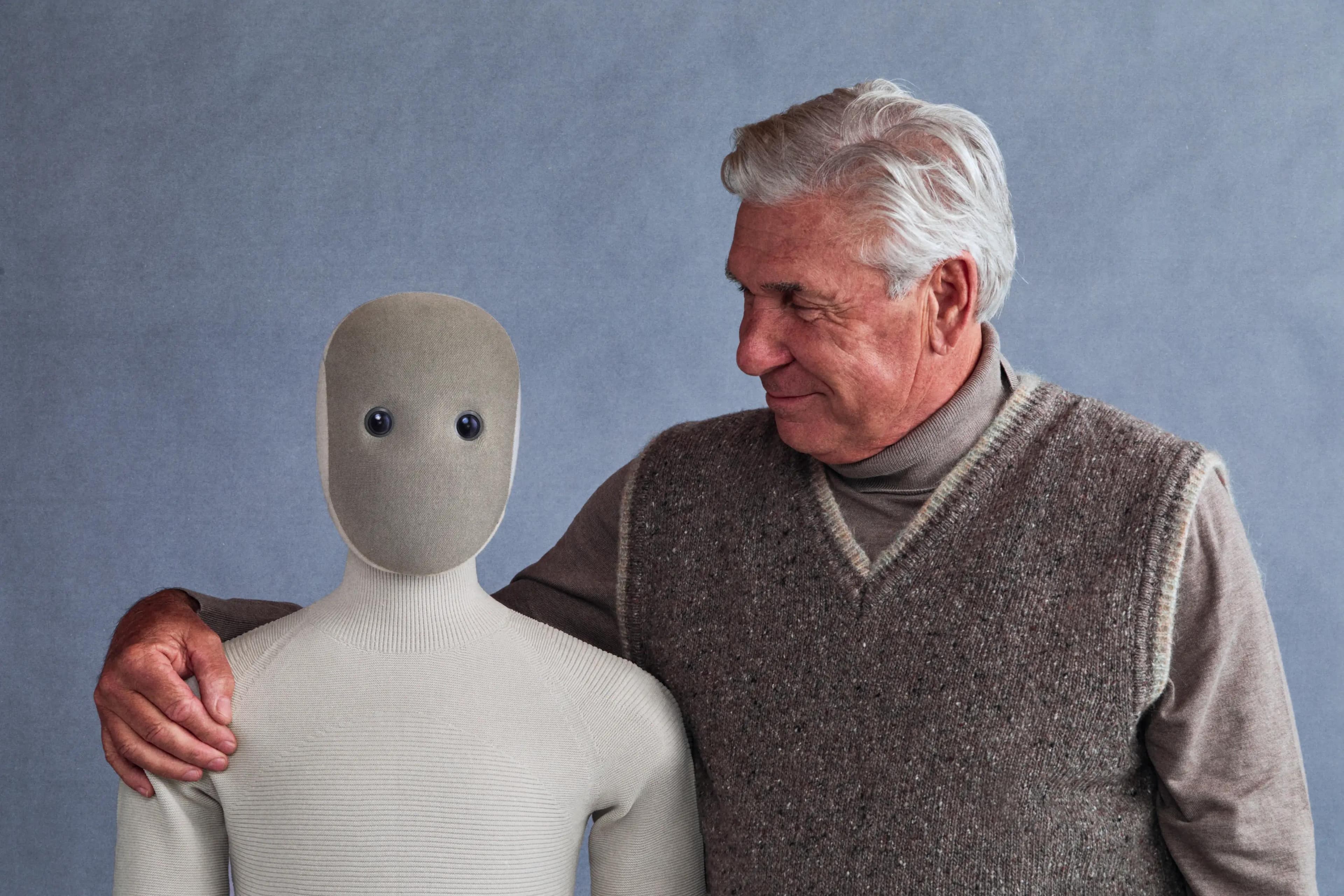
Most humanoid robots want to look like industrial equipment. Neo wants to look like a houseguest. Its body is wrapped in soft material — rubberized, slightly pliable — and at thirty kilos it weighs less than a child. The whole design is an argument that the second wave of humanoids will be quieter, smaller, and aimed at homes rather than warehouses.
1X has done something its competitors mostly avoid: it has been honest about teleoperation. The company's own order and product pages keep Scheduled Expert Mode and remote app/VR piloting explicit for unfamiliar or incomplete tasks. That kind of disclosure costs marketing horsepower but earns the trust premium in the Reality Score.
The company has also been more specific than most about the stack behind the product. 1X says NEO uses NVIDIA Isaac Sim and Isaac Lab in its simulation and training workflow, with Jetson Thor onboard compute for local multimodal AI inference; the order page additionally describes Redwood AI as the generalist model for learning and repeating chores. In June 2026, 1X also announced a World Model Lab led by Sam Sinha to push large-scale world-model pretraining for autonomous humanoids. In July 2026, 1X added a detailed hand update: 25-DoF tendon-driven hands, 22 fully actuated DoF across the fingers and palm plus 3 at the wrist, low-ratio quasi-direct-drive tendons, force control, and backdrivability. That is useful hardware and AI-roadmap transparency, not proof that the robot can already work reliably in homes without assistance.
The catch is the market. 1X is taking orders via a $200 deposit, and The New Yorker reported after visiting 1X that more than 10,000 customers had placed deposits for Neo. 1X also says its Hayward NEO Factory has started full-scale production while targeting first NEO shipments in 2026 and ramping toward an initial capacity of 10,000 units annually. Those are meaningful commercialization and manufacturing signals, but deposits are not deliveries: the same factory article says many current units are prioritized for internal development and home testing while the company iterates toward broader readiness, and The New Yorker also reported explicit teleoperation and uprightness caveats. Nobody has yet shown humanoid deliveries into private homes at meaningful volume. Neo is a hardware bet on a use case that does not yet have a proven customer base. If 1X reaches a hundred paying homes, the Reality Score will move quickly. Until then, it sits where it does.
Originally launched as "Neo Gamma" in February 2025; 1X now markets the product simply as "Neo."
Reality check
1X has been more transparent than most about what is autonomous and what is teleoperated. The published spec sheet is detailed, and the official order page now adds pricing, Early Access ownership terms, and richer hardware/AI-stack claims, but volume delivery into private homes remains unproven.
- Manufacturer spec sheet — 5'6" (168 cm), 66 lbs (30 kg), 55 lb carry payload, 4 hr battery
- Tendon-drive actuators (low inertia)
- 1X publicly discloses that an "Expert from 1X can remotely supervise" the robot for unfamiliar tasks
- Official product page accepts orders via a $200 deposit and still describes scheduled 1X Expert remote supervision for unfamiliar or complex chores
- Originally launched as "Neo Gamma" in February 2025; current marketing drops the suffix
- 1X says it uses NVIDIA Isaac Sim and Isaac Lab for simulation and training workflows, with NVIDIA Jetson Thor onboard compute supporting local multimodal AI inference on NEO
- 1X announced a World Model Lab in June 2026, led by Sam Sinha, to accelerate autonomous humanoids through large-scale world-model pretraining
- 1X says its Hayward, California NEO Factory is operational and in full-scale NEO production while first shipments are targeted for 2026
- 1X's official order page lists Standard at $499/month and Early Access ownership at $20,000 with three-year warranty, premium support, priority delivery, and a $200 refundable deposit
- 1X describes Redwood AI as NEO's generalist AI model for learning and repeating chores, while retaining Scheduled Expert Mode plus app/VR remote piloting for tasks NEO cannot complete unaided
- The New Yorker reported in June 2026 that more than 10,000 customers had placed deposits for Neo
- 1X announced new 25-DoF tendon-driven NEO hands, with 22 fully actuated DoF in the fingers and palm plus 3 at the wrist, and said the hands will ship on every NEO
- Consumer launch timing — repeatedly framed as near-term without specific dates
- At-home task autonomy in demo footage — most is hybrid, by 1X's own account
- 1X's AI-stack article improves transparency, but it does not independently prove in-home autonomy, reliability, delivered consumer units, or task success rates
- The World Model Lab announcement is official AI-roadmap evidence, not proof of current in-home autonomy, reduced teleoperation, delivered consumer units, or task success rates
- 1X's NEO Factory capacity and 2026 shipment language remain company-reported until customer deliveries, volume, usage, support model, and safety/autonomy performance are externally verified
- 1X order-page pricing, Redwood AI, camera, battery, compute, and ingress-protection details are manufacturer claims and commercial terms, not evidence of delivered units, autonomous home performance, reliability, support load, or privacy outcomes
- Deposit count is not delivery count; The New Yorker also reported explicit teleoperation and uprightness caveats, so deposits should not be treated as proof of autonomous in-home performance
- 1X's hand article and X video are official manufacturer evidence of the NEO hand design, not independent proof of sustained household task success, delivered customer units, safety record, or autonomy without remote help